
Genius AI

AI-Powered Underwriting Is Not a Replacement. It Is a Workbench.

Ask any mortgage underwriter what slows them down and you will not hear “risk modeling.” You will hear about chasing documents, conditions that pile up, and jumping between three systems to review one file. According to STRATMOR Group, underwriters spend 40 to 50 percent of their time on work that has nothing to do with the actual credit decision. That is the problem worth solving.
That is not an underwriter problem. That is a workflow problem. And that is exactly what an AI-powered underwriting workbench is built to fix.

The Numbers Every Mortgage Executive Should Know

Before making the workbench argument, it helps to be specific about where the pressure is coming from.
$11558
47 Days
~40%
44-46 days
Average cost to
originate one loan Source:
MBA IMB Performance Report, Q1 2025
Average time to
close, industry wide
Source: MBA / ICE
of underwriter time
on non-decisioning tasks Source:
STRATMOR Group, 2025
average time to close a
purchase loan Source:
ICE Mortgage Monitor, 2025
The 40 to 50 percent non-decisioning time figure is the operational lever. If your shop has 15 underwriters and nearly half their day is spent on work that does not require underwriting judgment, you are running the equivalent of 7 to 8 underwriters at full capacity. Recovering even a portion of that through a well-designed workbench changes your throughput without adding headcount.

What the Replacement Narrative Gets Wrong

There is a version of the AI-in-mortgage story that goes like this: feed the model enough loan data and it will underwrite better than a human . For conforming loans running through DU or LP, parts of that are already true.
But anyone who has worked in mortgage knows what happens after the AUS runs. The underwriter still reviews the findings, interprets risk flags, applies lender overlays, evaluates compensating factors, works through income documentation for self-employed borrowers, and manages a condition list that averages 8 to 12 items per file. That work does not disappear when the system returns an Approve/Eligible.

Where Underwriter Time Actually Goes in Mortgage

Here is a more specific breakdown of how a mortgage underwriter’s day is typically distributed and where AI workbench tooling has measurable impact:
Task
Est. Time Share
AI Workbench Impact
Stare-and-compare / data re-entry
15-20%
Up to 80% reduction
Condition management and tracking
10-15%
Automated queuing and status tracking
Document review and classification
10-12%
60-70% faster with intelligent document processing
TRID / ATR / HMDA compliance checks
8-10%
Embedded, real-time, no separate step
Borrower and file research
5-8%
One-click summaries with source citations
Actual credit and risk decisioning
30-35%
Amplified, not reduced

A Point-Solution AI Tool and a Workbench Are Not the Same Thing

Lenders adopting AI in underwriting often start with a document extraction tool or an automated condition checklist. These are useful. But adding them to an already fragmented workflow does not fix the fragmentation. It adds more tools to manage.
Capability
Standalone AI Tool
Indecomm Genius AI Suite Workbench
Loan file intake
Manual pre-processing required
Multi-format ingestion, auto-indexed
DU / LP overlay management
Separate manual review
Flagged findings surfaced in-flow
Condition management
Email and spreadsheet tracking
Automated queuing with aging visibility
TRID / compliance checks
Done late, manually
Embedded at the correct workflow stage
Underwriter guidance
None
Next-best-action prompts and risk flags
Audit trail
Assembled after the fact
Logged and traceable by default
Team collaboration
Email hand-offs
Integrated task routing and escalation
The distinction matters operationally. A workbench integrates data, process, and decisioning support into a single interface. The underwriter does not switch between the LOS, a document portal, a condition tracker, and a compliance tool. Everything runs through one environment, with AI handling the structured and repeatable tasks at each stage.

What Mortgage Operations Actually Need From an AI Workbench

Generic AI tools are not built for the compliance and documentation reality of mortgage lending. TRID timing rules, ATR documentation, HMDA data integrity, state‑level overlays, and agency guidelines all require domain‑specific logic and an audit trail that can stand up to regulators and investors. An effective underwriting workbench has to be designed around that world, not adapted to it after the fact.

In practice, that means a few non‑negotiables:

  • Clean file intake
  • Reliable income analysis
  • Guidelines and AUS in context
  • Audit‑ready by default
  • Automation between the cracks
Together, these Genius products cover document and data integrity, income analysis, decisioning, loan quality, trailing documentation, and workflow automation as one connected environment, not a collection of disconnected point tools

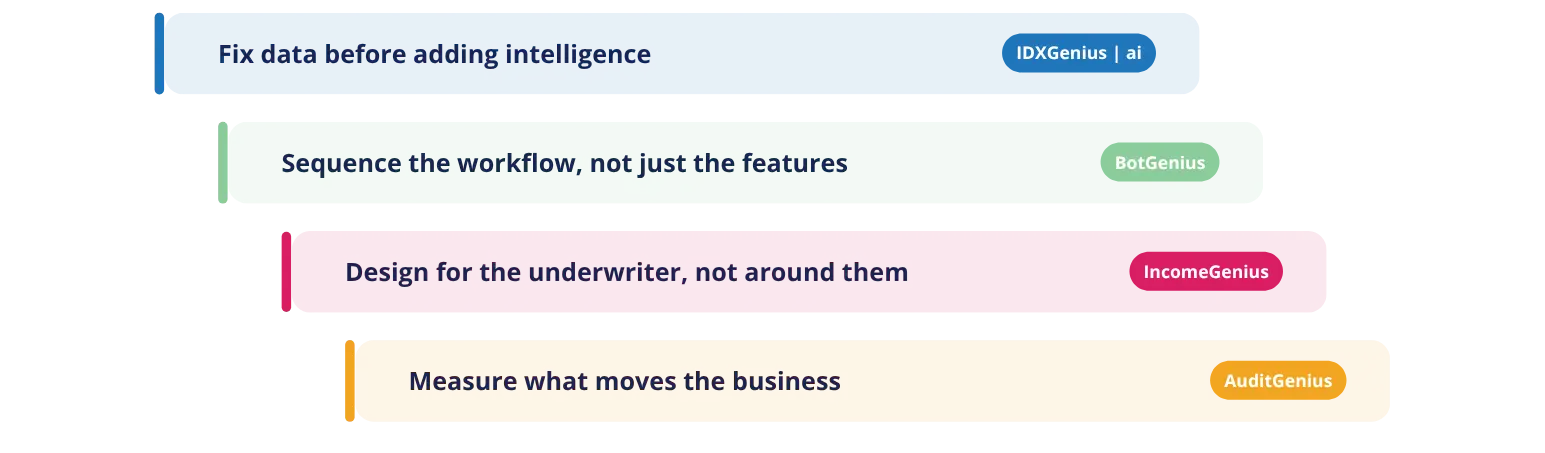
That is the design center for Indecomm’s Genius AI suite, anchored by DecisionGenius, the AUS workbench that puts credit, income, assets, and collateral in one place so underwriters have everything they need to make the call without switching systems. DecisionGenius pulls in income analysis through IncomeGenius and document data through IDXGenius|ai, so by the time a file reaches the underwriter, the numbers are already calculated, the docs are already classified, and the AUS findings are already surfaced in context. AuditGenius closes the loop on quality and compliance, and BotGenius keeps files moving between stages without manual hand-offs.

What Good Implementation Looks Like

The mortgage AI implementations that fail start with the technology and work backward. The ones that deliver results start with the workflow.

The Underwriter Is Still the Decision-Maker

The mortgage industry has spent years adding digital tools to the origination process. What has lagged is integrating those tools into a coherent workflow that actually reduces the burden on the people doing the work.
An AI-powered underwriting workbench is not a bet on automation replacing judgment. It is a bet on giving underwriters the environment they need to apply that judgment faster, more consistently, and with less friction on every side.
The lenders who close that operational gap now are not taking a risk on unproven technology. They are reducing the cost and capacity risk of staying on workflows that were already expensive before the current environment made every basis point matter more.
IncomeGenius. DecisionGenius. IDXGenius |ai. AuditGenius- each tool solves a specific problem in the mortgage underwriting workflow. Together, they are the Genius AI suite, built for mortgage from the ground up, not adapted from a generic platform.
We use cookies to offer you a better browsing experience, analyze site traffic, personalize content and serve targeted ads. We also share information about your use of our site with our social media, advertising and analytics partners who may combine it with other information that you’ve provided to them or they have collected from your use of their services. Read how we use cookies and how you can control them in our Cookie Disclosure Policy. By using our site, you consent to our use of cookies.