
Solutions
I AM A
I NEED
Company
Solutions
I AM A
I NEED
Company

Because most tools were built to digitize documents, not to guarantee data quality. The failures are quiet: misfiling, versioning issues, and undetected extraction errors that surface later as costly exceptions, not obvious breakdowns at intake.
4
silent failure points at intake
5
downstream costs they trigger
1
root cause: partial automation
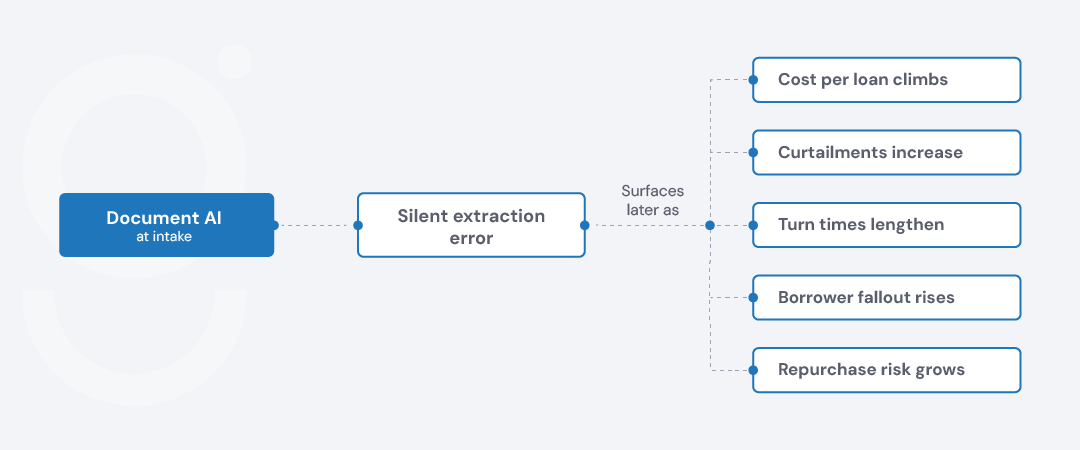
Where it shows up | Why it happens |
|---|---|
Cost per loan climbs | Manual document handling is labor-intensive at every touch: intake, indexing, exception review, and re-work when something gets missed. |
Curtailments increase | Investor deadlines do not care about your document backlog. When turn times stretch, interest shortfalls follow. |
Turn times lengthen | A loan that stalls because a document was misclassified or rekeyed incorrectly just feels like a slow lender to the borrower. |
Borrower fallout rises | Longer cycle times mean more opportunities for a borrower to get a competing offer, lose patience, or walk away. |
Repurchase risk grows | Document exceptions that should have been caught at intake surface later, sometimes long after the loan has been sold. |
01
Extraction without context
No visual link between an extracted value and its source. Reviewers open the PDF separately to hunt and verify.
02
Poor data organization
Related fields separated across pages. Reviewers mentally reconstruct relationships the software should preserve.
03
Cryptic outputs
Teams build job aids and manual lookups just to bridge the gap, creating dependency on institutional knowledge.
Highest-Risk Document Types
Income statements, VOEs, VOIs, and closing disclosures. These carry the most downstream risk and are exactly where generic tools consistently break down.
The better platforms do not replace human judgment. What they deliver is closer to a very fast, very consistent document specialist that feeds people cleaner inputs so they can decide faster.
Pre-classification & conditioning
Files are assessed, sorted, and conditioned before extraction starts. Low-quality scans and mixed formats are routine, not edge cases.
Extraction with context
Extracted data is tied directly to its source location, so validation is fast and does not require opening a separate PDF.
| Evaluation criteria | Generic OCR / LOS tool | Purpose-built platform |
|---|---|---|
| Optimized for | Extraction volume | Extraction accuracy |
| Pre-classification | Often skipped entirely | Built in before extraction starts |
| Data context | No link to source location | Extracted fields tied to source |
| Data layout | Fields scattered, random order | Mirrors document layout |
| Anomaly detection | Manual recheck | Automated, on every loan |
| Integration | Sits outside core stack | Bidirectional with LOS & servicing |
Integration depth
A platform outside your core stack will not deliver its promised value. Bidirectional integration with your LOS, servicing system, and repositories is what makes zero-touch processing work.
The right metrics
Document coverage, field-level accuracy, straight-through processing, and reduced human touches per file. Speed helps, but accuracy drives downstream value.
Messy-document handling
If a demo only shows clean, well-formatted files, ask how it handles the messy documents your team actually receives every day.
IDXGenius | ai was built specifically for this problem: proprietary machine learning, generative AI, and AWS infrastructure handling document-heavy processes across the full mortgage lifecycle, from origination through servicing and into capital markets.
Loan setup
Underwriting
Post-closing QC
Servicing onboarding
MSR transfers
Due diligence
Pre-classification and conditioning are built in, not bolted on. Complex document types, including income, VOE, VOI, and closing disclosures, are handled with accuracy rates that generic tools do not achieve. It configures around your existing workflows rather than forcing your team to rebuild their process around a new tool.
For lenders who have already invested in document AI and are still fighting the same problems, IDXGenius | ai is built to close the gap.
Because having document AI and having working document AI are not the same thing. Existing solutions solve digitization, not data quality. If your team is still doing manual rechecks, hunting for source context, or building workaround job aids, the gap is costing you downstream even though the tool is technically in place.
Income statements, VOEs, VOIs, and closing disclosures. These carry the downstream risk and are exactly where generic, non-mortgage-specific tools consistently break down.
A generic tool is optimized for extraction volume, getting documents digitized and processed quickly. A purpose-built platform is optimized for extraction accuracy in a mortgage-specific context, with pre-classification, source-tied extraction, reviewer-native organization, and automated anomaly detection.
Ask about bidirectional integration with your LOS, servicing system, and repositories. Ask for document coverage, field-level accuracy, and straight-through processing metrics, not just speed. Ask specifically how the platform handles messy, low-quality, or mixed-format documents, not just clean demo files.
[ninja_form id=2]